
Background
This is the branching story I created for Scott Kildall’s Exotopia project. Each season of the project would have unique 30-day stories depicting a spaceship exploring one of the known exoplanet systems for the first time. Ticketed customers would be assigned to a role in the story, and would receive their unique version of the story in daily episodes on their smartphones.

I wrote the story for the first season, which had 80 customers/tickets, and my ship, Aquarius I, was heading off to the TRAPPIST-1 system, specifically to investigate the planet TRAPPIST-e, a planet suspected to be within a habitable “Goldilocks Zone.” I was able to coordinate with researchers and scientists from the SETI Institute to help ground my fiction in current scientific understanding (the James Webb Space Telescope was scheduled to begin investigating the TRAPPIST-1 planets shortly after we finished this project, and it may have made some of the details of my story obsolete — such is life for a sci-fi author).
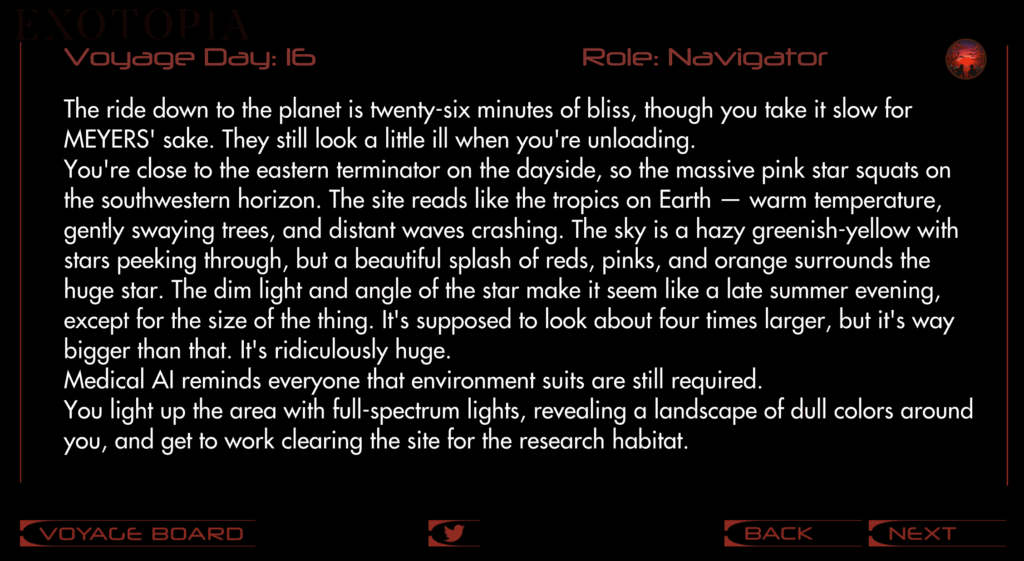
The episodes were intended to be delivered to customers’ smart phones and shared via Twitter, so the word count and line count of each episode was constrained to fit on a single screen of a normal smart phone (in 2022). Roles and story branches were pseudo-randomly assigned by Scott. Some story branches ended earlier than others, though we ensured everyone made it through the first week or so (space travel is dangerous!).
I also collaborated with visual artists Samantha Tan and Gray Cooke who created digital art pieces (NFTs) that were delivered with poignant episodes. You can see some examples of Gray’s NFT art on his site site: https://www.gjkcooke.com/portfolio/exotopia
My GM and writing buddy, Rebecca Demarest, was the author for the second season of Exotopia, where they traveled to the exoplanet TOI-1452b.
Try it out
Without the background coding that Scott did, the stories are more like a Choose Your Own Adventure book, though the choices are pretty obvious (Good/Bad). The good news there is, like the CYOA books, you have the ability to step backwards if you get stuck in a bad spot.
There were three roles: Basic Crew, Command, and Navigation. The majority of the story elements are in Basic Crew (where the majority of customers were assigned). Command and Navigation have some unique episodes in their overall story, but most of the episodes are shared with the Basic Crew story. Also, Scott provided the sci-fi fonts, borders, and aesthetics, so what I have here will be pretty basic text boxes.
Click here to launch the story in your browser.
Tools
As always, I used Scrivener to write the story and keep track of the episodes. To create the branching structure and links, Scott wanted to use Twine. I hadn’t used an application like this before, so it was a fun educational journey. Twine has a lot of cool stuff built in for including graphics and complex logical operations to guide the story based on saved variables, but all of the randomization was done by a DIY coding environment that Scott was using. It’s on my list to research Twine some more and maybe create a more interesting story in the style of the old Choose Your Own Adventure novels. We’ll see.

Links
Exotopia website: https://www.exotopia.xyz
Scott Kildall: https://www.kildall.com
SETI Institute: https://www.seti.org
TRAPPIST-1 on wikipedia: https://en.wikipedia.org/wiki/TRAPPIST-1
Samantha Tan: https://grayarea.org/community-entry/samantha-tan/
Gray Cooke: https://www.gjkcooke.com
Rebecca Demarest: https://rebeccademarest.com/
Twine: https://twinery.org/